
Let’s make the kitchen an extension of you.
Your tool. Your aid. Your expression. Your place to regain your strength and happiness.
And it all begins with the people who will live there.
As your kitchen designer, I will ask you questions. Because I want to know.
I want to know what soothes you, what annoys you, what fulfils you. What makes life easier. What makes it more enjoyable. And that matters for everyone who will live in and use the kitchen.
So, what do you enjoy doing in your kitchen?
What do you do every day?
What do you wish was easier?
What takes up a surprising amount of your time?
And what would you love to have a little more space, freedom or pleasure to do?
What’s important to you?
The question from which the whole design begins.
Because two people can have exactly the same size space and need completely different kitchens.
For one person, baking may be the heart of the room. For another, it might be breakfast with the family, entertaining friends, preparing delicious meals, making and enjoying coffee, sharing the kitchen with a home office, or simply having everything beautifully organised and easy to reach.
Your kitchen should reflect those priorities.
From a kitchen full of cabinets to a kitchen full of purpose
I will measure your kitchen down to the millimetre. I will study the room, its proportions, its natural movement and the most appropriate locations for the key functions.
But I will not simply fill it with cabinets.
Instead, I will look at what the space needs to do.
I will give you options that make sense. Surfaces that are delightful to interact with. Shapes that are pleasant to look at. Storage that is easy to use. Functions that genuinely fulfil their purpose.
A kitchen designed with thought, intention and respect for the way you live.
Expanding and putting back together
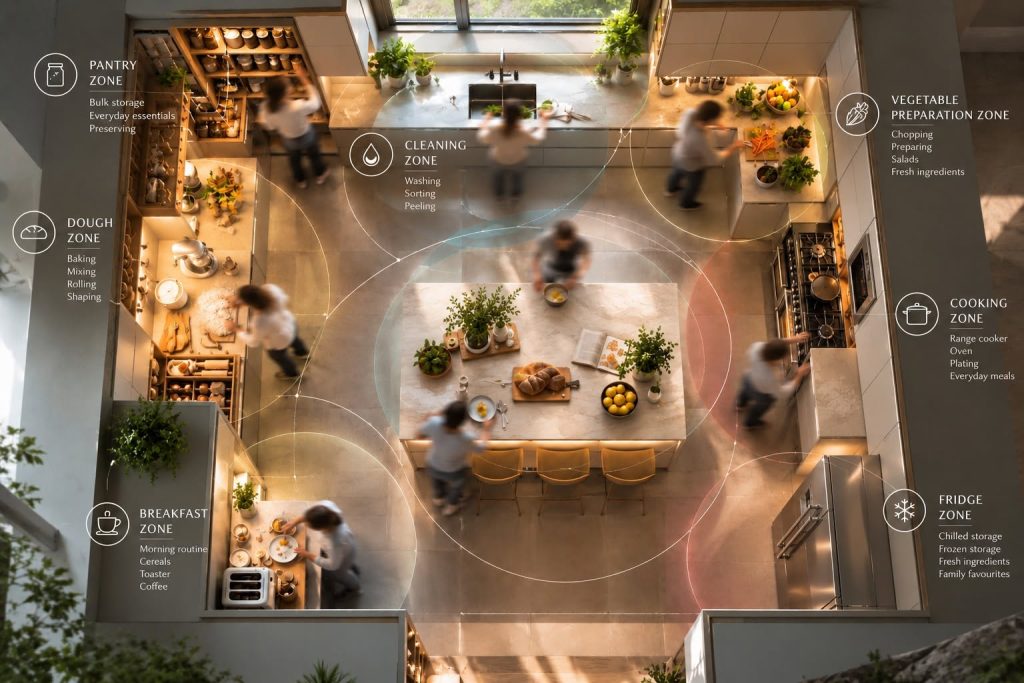
There is a useful concept in engineering called functional isolation: breaking a complex system into independent functional modules, each designed to perform a specific task, while allowing the modules to work together as part of the whole.
The same principle can be applied to a kitchen.
A Cooking Zone can be designed around heat processing. A Breakfast Zone around the morning routine. A Coffee Zone around the ritual of making and enjoying coffee. Each Zone is considered in its own right, according to what you need it to do.
We first expand and classify your needs, identifying the activities, equipment, ingredients and storage each Zone requires.
We then bring them back into the framework of your space, resolving how they overlap, connect and share resources.
The individual Zones become part of a larger system, carefully integrated so that the kitchen works as a whole.
The Zones come together to form one kitchen.
Choose what matters to you
Once we have identified the possible Zones, the next step is to decide which of them matter most to you.
Imagine being able to look at a collection of kitchen themes and simply say:
This is important to me.
Perhaps you choose:
Breakfast with partner + Cooking + Evening cuppa
Another client might choose:
Coffee + Entertaining + Home Bar
Someone else might choose:
Pantry + Children’s homework + Family Meals
There is no universal combination.
And that is precisely the point.
Your selection begins to reveal how you actually use your kitchen, what you enjoy doing there and where the kitchen needs to work hardest for you.
The more important an activity is to you, the more thoughtfully we can design around it: the storage, the equipment, the working surfaces, the positioning and the ease of access.
This is where priorities become design decisions.
We give greater attention to what matters most, while making sure that all the individual Zones come together as one cohesive kitchen.
The kitchen does not need to look like a collection of specialised areas. It should feel elegant, balanced and considered as a whole.
The personalisation lies in how intelligently the space works for you, rather than in making the design so specific that nobody else could make it their own.
Integration and interaction
A well-designed kitchen is not a collection of isolated Zones.
It is a natural flow of activities, balanced by proportion, rhythm and visual continuity.
The Zones overlap. They flow into one another. They support and complement each other. They share resources where it makes sense.
A coffee machine might serve the morning routine as well as entertaining. A generous work surface might support baking, family meals and everyday preparation. Storage might serve several purposes depending on when and how it is accessed.
This interaction is what makes the kitchen feel natural.
You should not have to think about where one Zone ends and another begins.
You simply move through the space, doing what you came there to do.
The result is a kitchen that is highly considered in its function, yet calm and cohesive in its appearance.
From functions to one kitchen
Once the important Zones have been identified, we can begin to bring everything together.
We consider:
What matters to you → what each activity requires → what needs to be stored → how it is used → how much space it deserves → how the Zones interact → how everything fits the room.
There is no separation.
The Zones have their own identities and priorities, but they share resources where that makes sense. Their boundaries remain flexible, and their individual requirements are resolved within one coherent design.
This allows us to make much better sense of the available space than relying on the traditional working triangle alone.
The kitchen is no longer assembled simply around appliances and cabinets.
It is assembled around the life that takes place inside it.
And although the design begins with you, it does not have to be visually exclusive to you.
A kitchen can be deeply personal in the way it works, while remaining elegant, balanced and timeless in the way it looks.
It can give you exactly what you need, while leaving room for someone else to make it their own one day.
Designed for you. Considered as a whole.
Be Zen in Your Zone
What if your kitchen could make you feel more like yourself?
Not simply beautiful.
Not simply practical.
Not simply “your style”.
But unmistakably you.
Uniquely yours.
Cleverly resolved.