Dough Zone
I would like to start this section with a subject that is close to my heart: baking.
Although I am not a frequent baker, there were times when I dipped myself into the mysteries of making sourdough bread from a homemade starter and perfected my sponge cake base. We had a lot of fun with mouldable fondant on birthday cakes and regularly made Pirohy, filled pasta that requires rolling and cutting on a board.
I understand that baking is a special passion, and a dedicated nook would be a perfect treat for any baking enthusiast.
But what interests me here is not baking itself. It is what baking can teach us about kitchen design.
Start with the person
Every baker is different. A sourdough enthusiast, a cake decorator and someone who regularly makes Pirohy will have completely different requirements.
The ingredients, tools, appliances and working space should therefore reflect what the person actually does, rather than what we assume a kitchen should contain.
Design around the activity
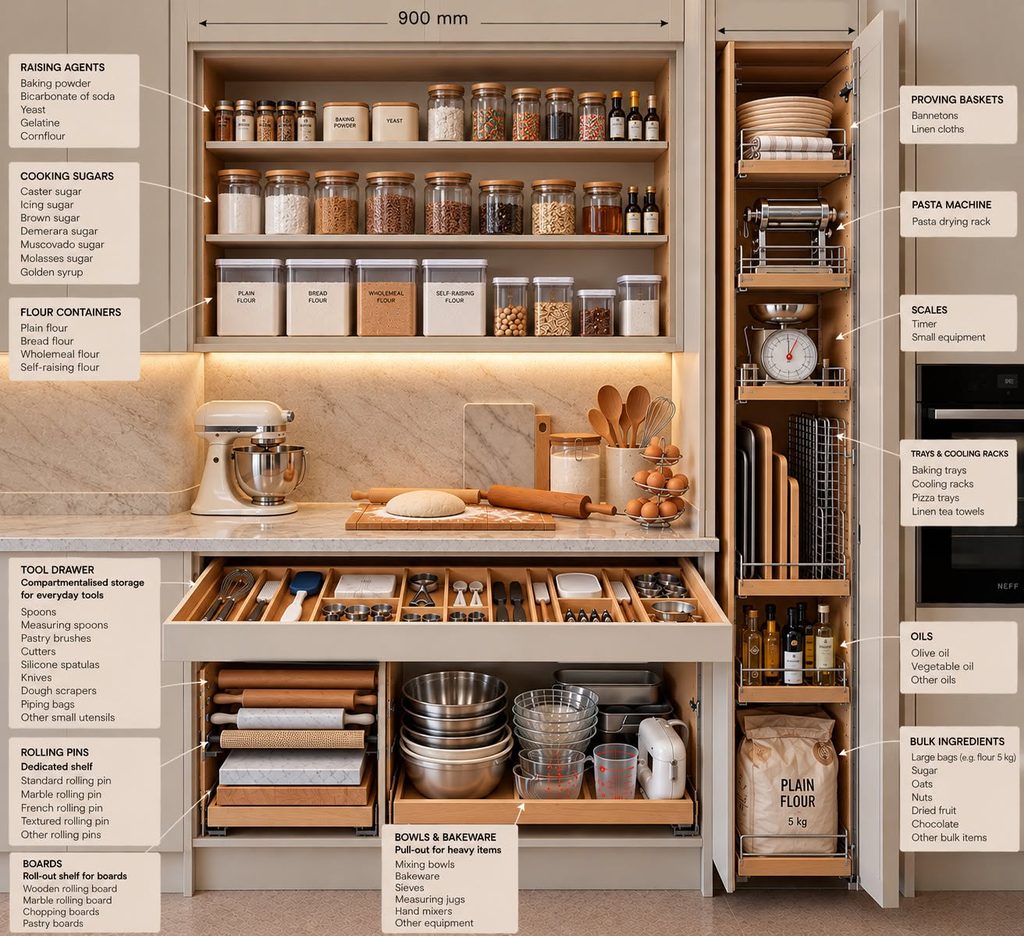
I like worktops to be deeper than the standard 600 mm where the design allows it. For a Dough Zone, those extra centimetres can make a real difference.
A generous rolling surface needs room not only for the dough board, but also for your hands, elbows, ingredients and tools. The storage around it should then follow the same logic: rolling pins, boards, bowls, baking trays and everyday utensils each have their own requirements.
Form follows function.
Think about the workflow
A Dough Zone should not exist in isolation. Its position within the kitchen matters: the sink should be conveniently close for preparation and the addition of water, while the oven should be within easy reach when the dough is ready to bake.
The most successful zones are not separate islands of activity. They connect naturally with the zones around them, creating a kitchen that flows.
Give everything its place
I would want to know what my client actually uses before deciding how their storage should work.
Perhaps it is a favourite palette knife and turntable stand for cake decorating, a particular rolling pin or a collection of dough cutters.
Good kitchen design doesn’t simply provide storage. It gives the things you use most a place where they make sense.
My role is to listen to what you love, understand how you use your kitchen and sometimes uncover the things you have always wished it could do. The reward is a space where you can simply get into your zone, lose track of time and enjoy what you love doing.